

You’ve invested months of development and thousands of euros into a mobile app, but after its release, organic downloads aren’t growing, and paid user acquisition is becoming unsustainably expensive. In the saturated Apple App Store and Google Play, a product’s survival depends on its visibility and its ability to convince users within a matter of seconds.
Imagine a situation where a team delivers a top-notch app, the marketing team launches campaigns, but the expected influx of users never materializes. Users either can’t find the app in the app stores at all, or they leave its profile page without clicking the download button. In an environment where Apple and Google offer millions of alternatives, invisibility is the fastest path to the failure of the entire project.
App Store Optimization (ASO)
This is where App Store Optimization (ASO) comes into play. It is a systematic process of increasing an app’s visibility and appeal directly within digital stores. The goal is to convert users who are actively searching for solutions to their needs into actual downloads. According to official statements from Apple, searching the App Store has long been the primary way people discover new apps.
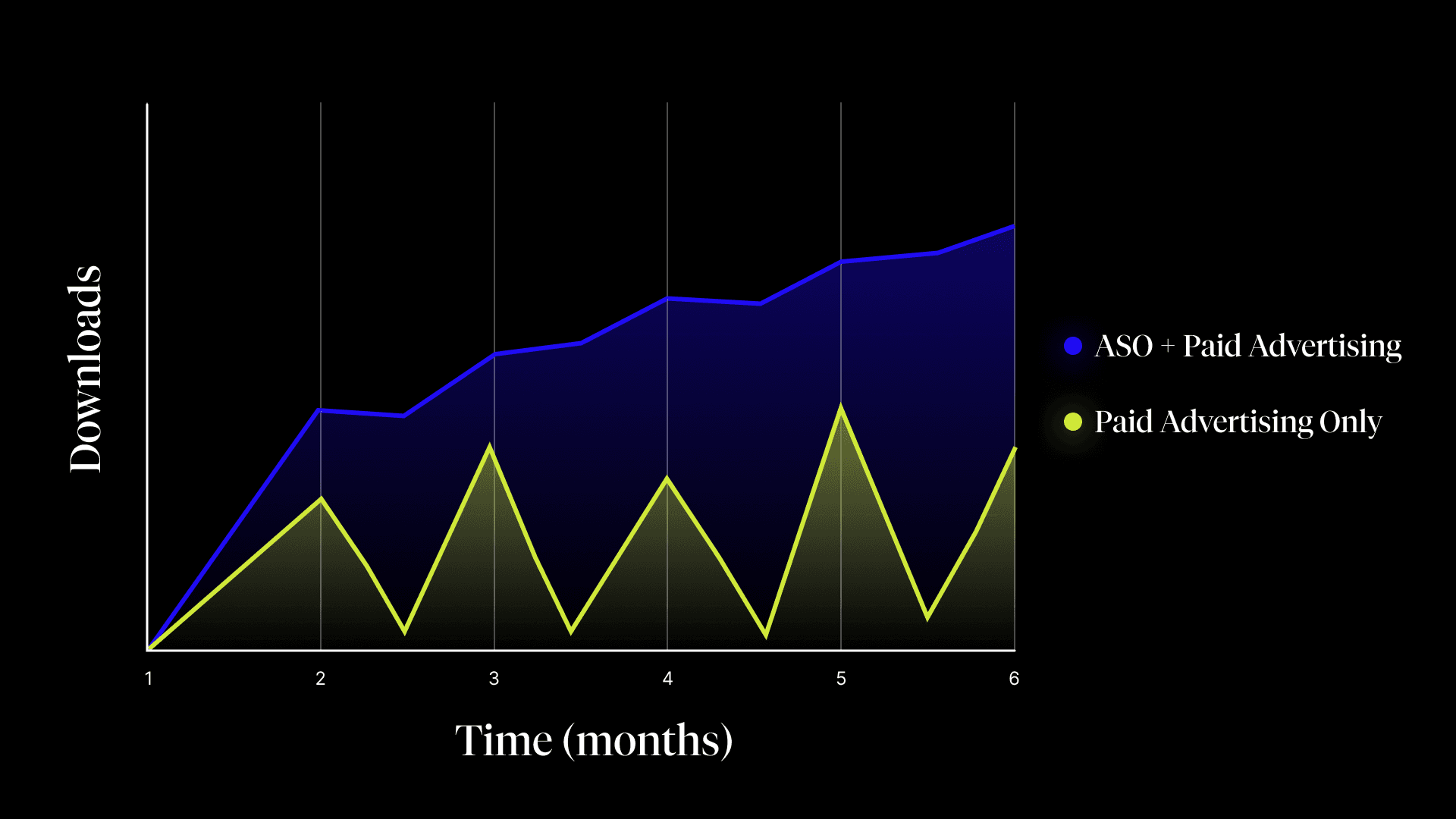
However, for ASO to deliver predictable results, we must first understand the rules by which Apple and Google evaluate apps.
What Really Determines Success in App Stores
Modern app store algorithms have long since stopped evaluating apps based solely on the mechanical repetition of keywords. Today’s search results are driven by the behavior of real users, which means that a product’s technical quality directly influences its marketing success. In this regard, three key metrics are crucial for teams:
- User Retention Rate: The App Store and Google Play algorithms track how often, and whether at all, people actually open an app after downloading it. Global benchmarks show that the average mobile app loses up to 77% of its active users within 3 days of download. If a large percentage of people delete it immediately, the system interprets this as a sign of low quality and ranks the app lower in search results.
- Quality and Frequency of Ratings: The average star rating is a key factor in whether a user will even consider an app. According to real ASO data, only a critical 15% of people are willing to download a 1- or 2-star app. However, once you move the product into the safe zone of 4 to 5 stars thanks to technical and user experience quality, this number jumps to 94%, representing more than a sixfold increase in conversion.
- Download Velocity: This metric measures the volume of installations over a short period of time. For the algorithm, this is a clear signal that the app is currently in demand on the market, which helps it climb the trend charts.
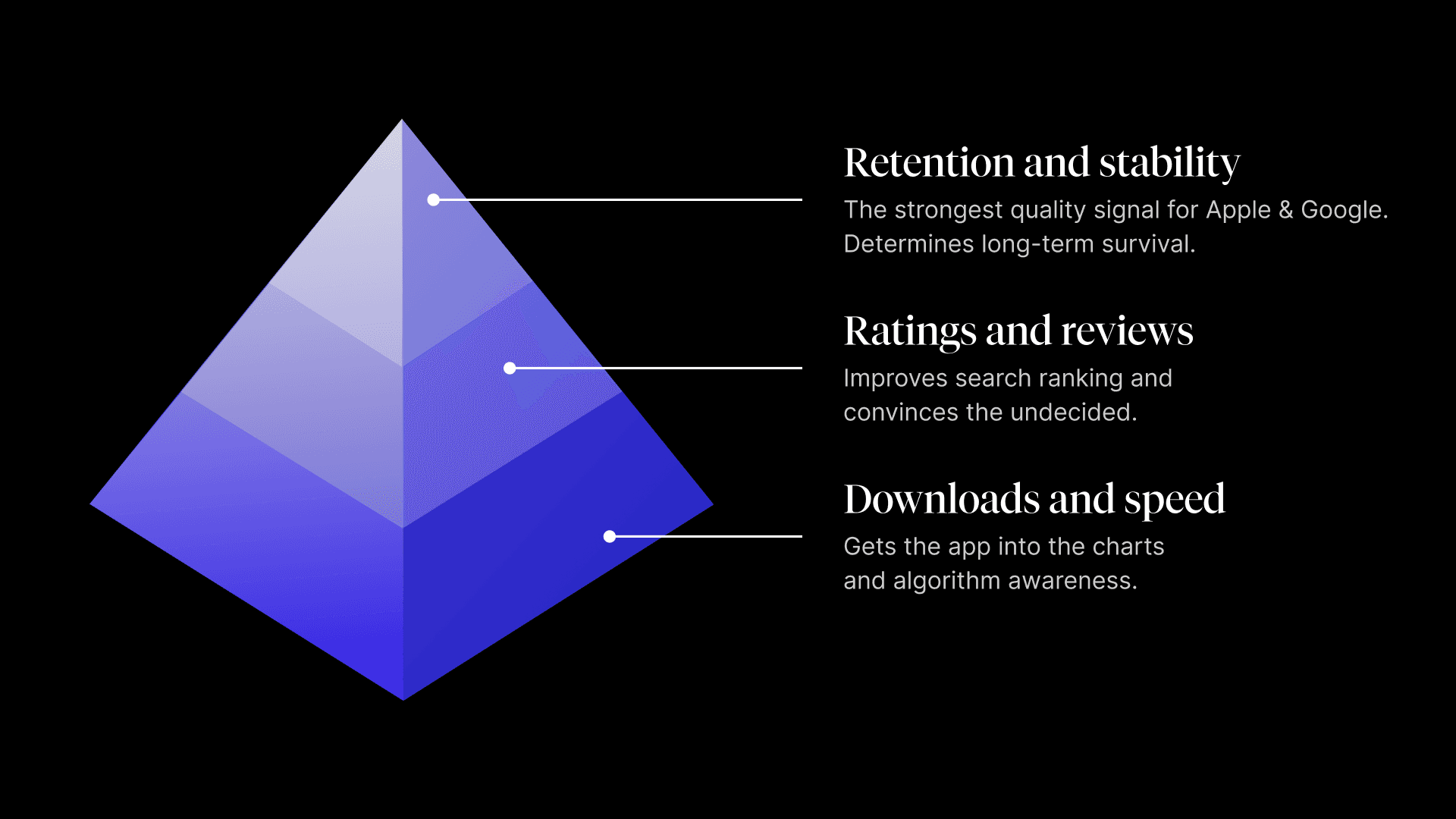
If you can keep these three technical and product metrics in the green, the algorithms will start to push you forward organically. In practice, this means you’re building a steady stream of users whose traffic you don’t have to constantly pay for on ad networks. Ultimately, ASO directly reduces the average cost per customer (CAC) and significantly increases the return on your total investment in product development.
Essential Foundation: Visual and Textual Presentation
When a user finds your app in a search, the decision-making process shifts to the visual and textual elements on the product page. The first point of contact is the icon, which must be clearly recognizable and understandable even at the lowest resolution on a smartphone screen.
Screenshots carry the most weight. The overwhelming majority of people make a decision based on the first two or three screenshots they see without having to scroll. These visual elements should immediately convey the app’s primary business value and key features in a real-world context. Furthermore, according to product analytics, implementing preview videos can increase the page’s overall conversion rate by up to 35%, as they demonstrate the actual use of the interface even before installation.
These visuals are complemented by metadata – the app’s title, subtitle, and description. The text must be concise, engaging, and naturally incorporate relevant keywords. The approach to these elements varies by platform: while Apple primarily recognizes hidden keyword fields and does not index the long description, Google Play scans the entire description text, similar to traditional web SEO.
Furthermore, sustainable growth in international markets is not possible without thorough localization. This involves not only literal translation but also adapting visual examples, cultural context, and local expressions to the specific audience in a given country, which significantly enhances brand credibility.
Modern ASO: Advanced Native Tools That Boost the Effectiveness of Marketing Campaigns
In recent years, both app stores have developed tools that enable marketing and product teams to precisely target specific user groups and maximize the return on investment for their campaigns.
Custom Product Pages (Custom Store Listings)
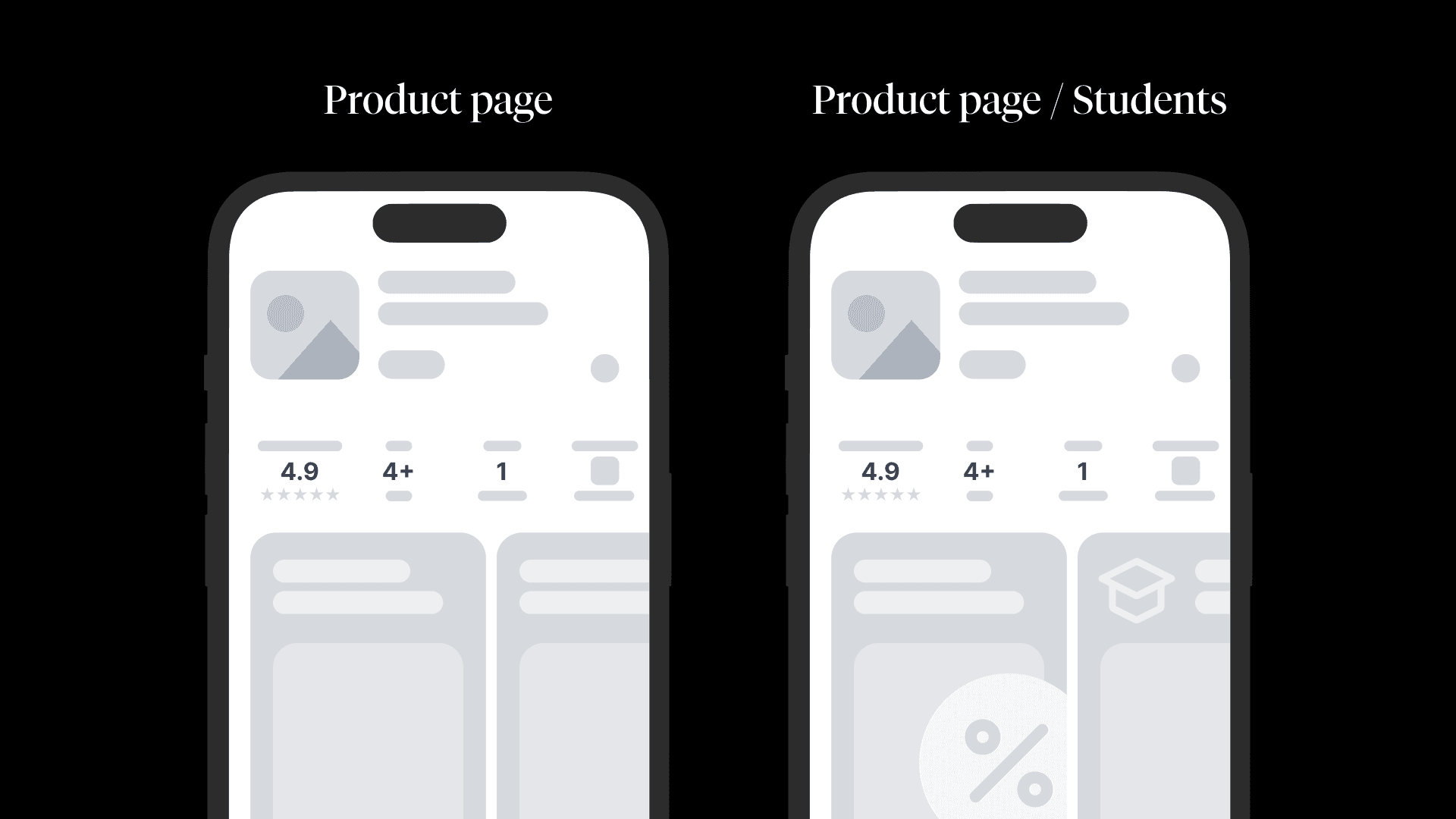
This tool directly addresses the problem of low conversion rates in paid campaigns. It allows you to create dozens of unique versions of a product page, each with its own URL. For example, if a fintech app targets students with a campaign focused on quick payments, it uses a specific URL to direct them to a page that highlights features specifically for students. If a campaign targeting an older audience focused on investing is running simultaneously, this group will see completely different visuals and copy tailored to their needs, which dramatically increases the campaign’s success.
Product Page Optimization (Store Listing Experiments)
These features bring data-driven A/B testing directly into production. Developers can deploy alternative versions of icons, videos, or screenshots, and the system automatically splits traffic between them. Based on actual user behavior, the platform then identifies the version with the highest conversion rate. This approach definitively eliminates guesswork in design and replaces it with data.
In-App Events (Promotional Content)
These allow you to promote time-limited events, updates, or seasonal offers directly in search results and in the recommended sections of app stores. This is an effective way to re-engage and reactivate users who have already downloaded the app but have stopped opening it regularly.
App Store Nominations & Google Play Featuring
In the past, the chance to be featured in an editorial selection and receive free promotion directly from Apple or Google was unpredictable. Today, Apple allows developers to use the console to directly nominate key app milestones for consideration by the editorial team. Google Play relies primarily on the technical health of the product for this selection, with algorithms closely monitoring low crash rates, stability, and growing retention.
How to Build a Sustainable ASO Strategy
Successful optimization requires integrating the work of product managers, developers, and marketers into a single, cohesive process.
- Implement continuous keyword research. The selection of phrases must be based on real data regarding search volume and relevance to your business. Relevance should always take priority over sheer search volume. The goal is to attract users who genuinely need the app and will use it over the long term.
- Proactive review management. The development team should implement native system prompts for app reviews, but only at moments when the user has successfully completed a process or achieved a positive outcome (for example, after successfully submitting a payment or having a request approved). An important part of building a good reputation is also responding regularly to reviews, especially negative ones, where the team provides direct technical support.
- Linking ASO with paid acquisition. Data from advertising platforms such as Apple Search Ads or Google Ads provides precise information on which keywords generate actual conversions and business value. These findings are then fed back into adjustments to the app’s organic metadata.
Conclusion
Launching an app in app stores is just the beginning of the product lifecycle. ASO is not a one-time project, but a systematic optimization process that directly impacts the return on investment in development. A properly designed metadata architecture, continuous A/B testing of visuals, and the use of modern personalized pages enable a business to grow even in a highly competitive market without the need to increase advertising budgets uncontrollably.