

We often hear concerns that technical debt hinders innovation. The truth is that a modern digital layer can be built as a standalone product on top of a legacy core system. The stable core remains untouched, while the business can roll out new digital services without the risk of disrupting operations.
In conversations with potential clients from the financial sector, we regularly come back to the same topic. The company has ideas for new products ready to go, but their implementation has stalled due to concerns about what could go wrong when you tamper with the old core system. In an environment where every decision carries enormous weight, this caution is completely natural. No one wants to risk the stability of a functioning business for the sake of an uncertain experiment.
Why legacy systems act as a trap
Core systems in banks and insurance companies manage critical data and transactions, where even the slightest error has a direct impact on clients or regulators. These systems typically involve a vast number of dependencies on other internal applications and integrations with third parties. As a result, even the smallest change requires complex coordination across multiple teams and external vendors.
Added to this are real capacity and staffing constraints. The specialists who manage the core system are primarily burdened with its maintenance and day-to-day operations, leaving them no room for development. Furthermore, detailed knowledge of the system’s architecture is often tied to a limited number of specific individuals, which significantly hinders substitutability and the transfer of know-how. The result? Changes that the business needs to implement immediately take months to roll out due to the sluggishness of the old system.
However, the solution to this situation is not an attempt to better coordinate two distinct worlds, but rather their thorough architectural separation.
Stable core and a modern user experience are two distinct disciplines
This is a crucial distinction that is often overlooked in failed projects. The core system and the digital front end have completely different priorities, technology stacks, and paces of change.
The main task of the core system is to store data and execute transactions reliably, securely, and in an auditable manner. The priority here is stability and the absolute minimization of risk, which naturally requires a slower and more cautious pace. In contrast, a digital product is meant to provide users with a fast, responsive, and personalized interface. Its priority is flexibility and continuous improvement based on market feedback.
If these two disciplines are combined into a single entity, inefficiency results. Either the digital product stagnates because the core system cannot respond quickly enough, or the stability of the core itself is compromised due to changes that are technologically out of place within it. The solution is integration via a separate layer that ensures controlled and secure communication between both environments.
New layer as a standalone product
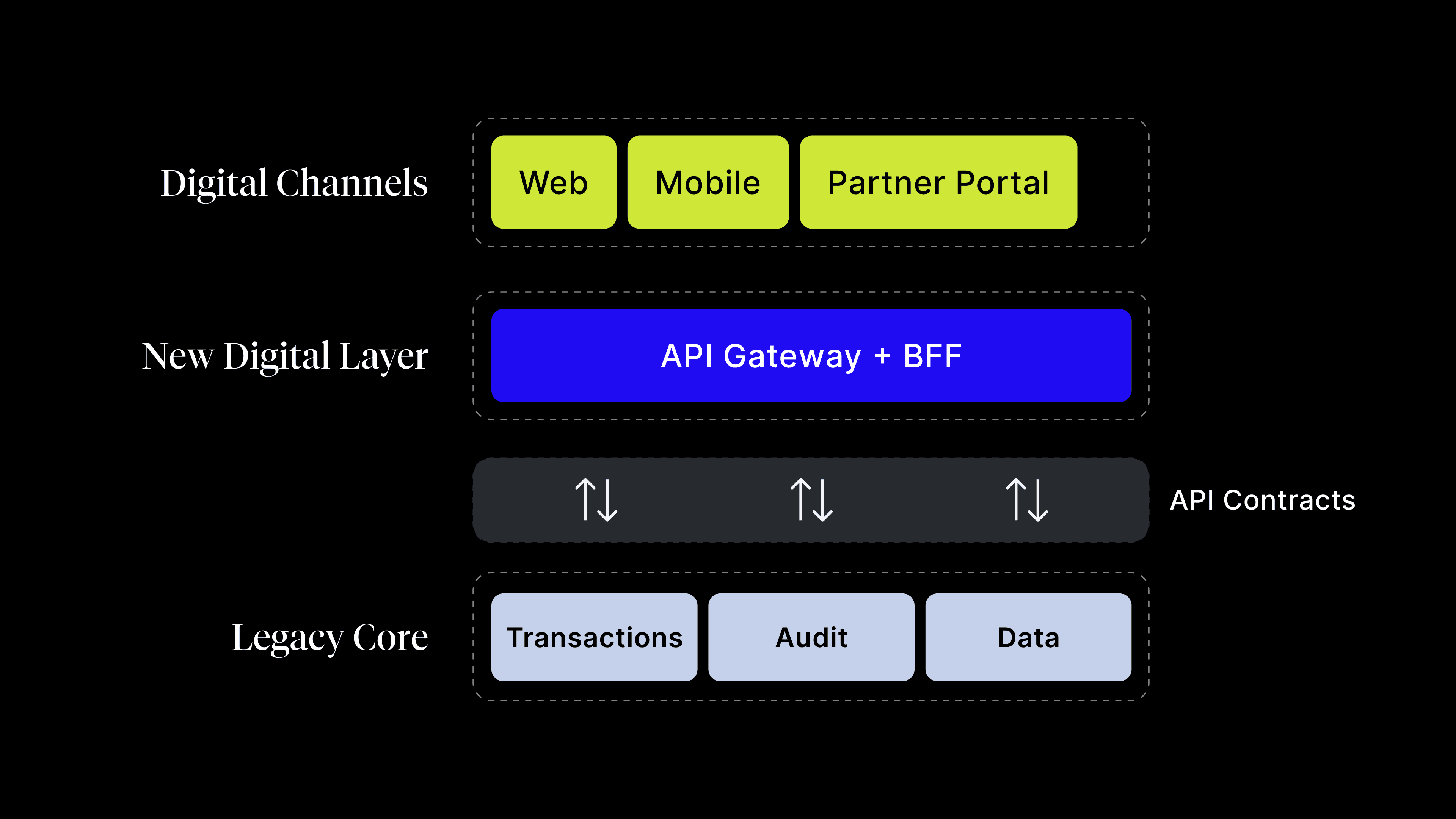
The target state we recommend to our clients is to build a digital layer as an autonomous product, regardless of whether it is a website, a mobile app, or a client portal. This layer has its own development team, an independent release cycle, and clearly defined goals.
This means that the new layer runs on its own integration backend, which communicates with the core system via strictly defined APIs. Thanks to this, you can implement business changes and design adjustments without any impact on the stability of the core. Furthermore, the entire layer has its own infrastructure for monitoring, security, and caching, making it independent of the performance limitations of the old system.
This approach naturally entails additional costs for managing the new layer. However, our experience with projects in the banking and fintech sectors confirms that these costs are significantly lower than the losses associated with a situation where every front-end modification paralyzes the core team’s development capacity. The core system remains protected, the digital product progresses at its own pace, and internal resources do not have to be divided between maintenance and innovation.
Proven technical approaches
In practice, there are several patterns that have repeatedly proven effective when building a modern digital layer on top of a legacy system. Each has specific business benefits and limitations that tell its own story about how to gradually transform the system.
API integration layer
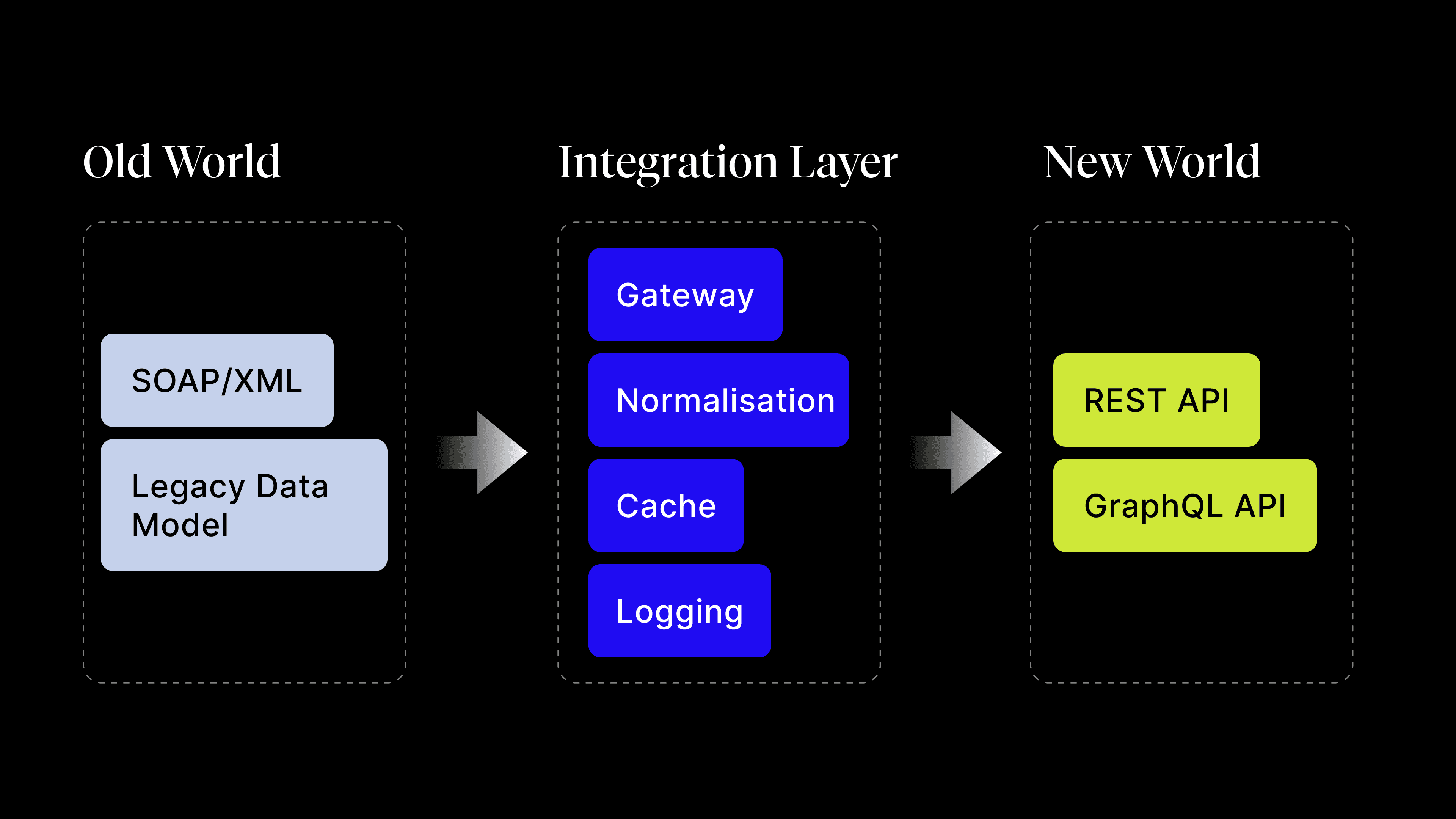
This approach isolates the core system from the external environment by transforming older protocols and formats into modern, clean interfaces. It facilitates translation between the legacy data model and the domain language of new applications, while managing access rights, limits, and logging. However, it is important to note that this layer is entirely dependent on the quality of the input data. If the core system provides inconsistent data, the integration layer can transform it but cannot correct logical errors.
BFF (Backend for Frontend)
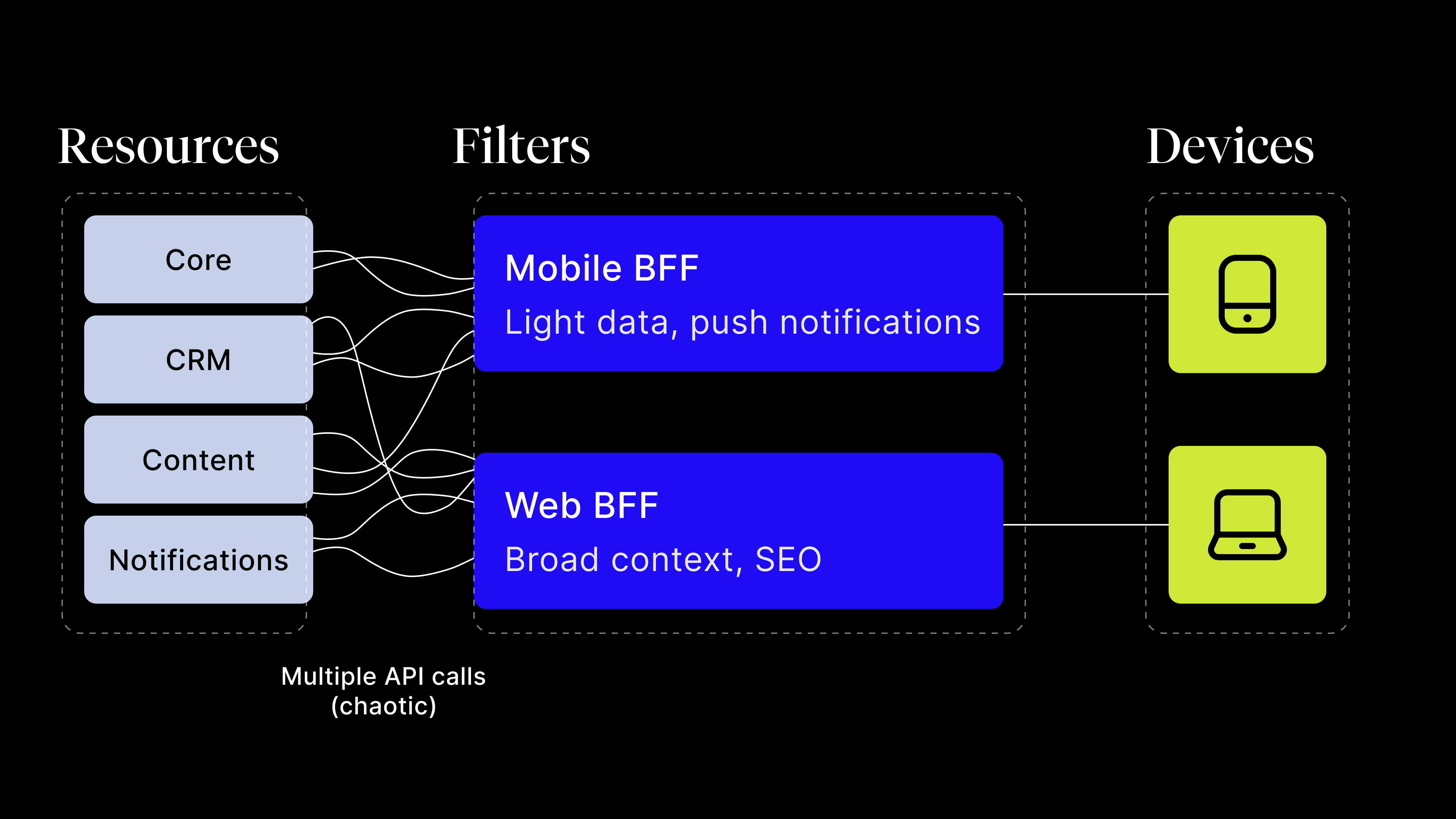
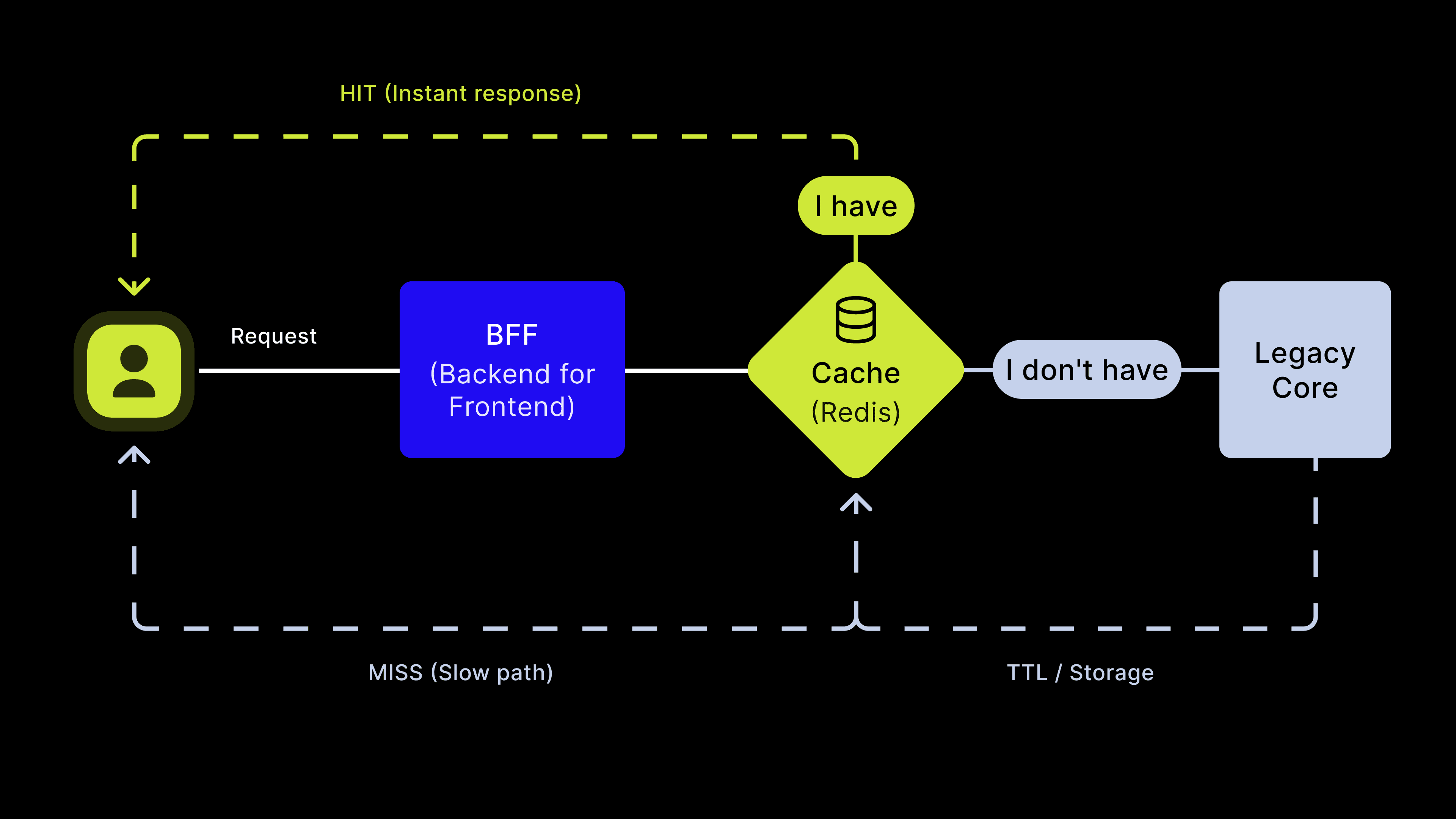
The BFF architecture adapts to the needs of a specific client channel, so both the mobile app and the web portal have their own solutions. At the same time, it aggregates data from multiple subsystems and delivers it to the front-end application in a single optimized call. The mobile app thus downloads only the amount of data necessary for a smartphone, while the web works with a more complex context. The limiting factor here is the risk that you’ll start transferring complex business logic that belongs in the core to the BFF layer. Over the years, this would create new, hard-to-manage technical debt.
Strangler pattern
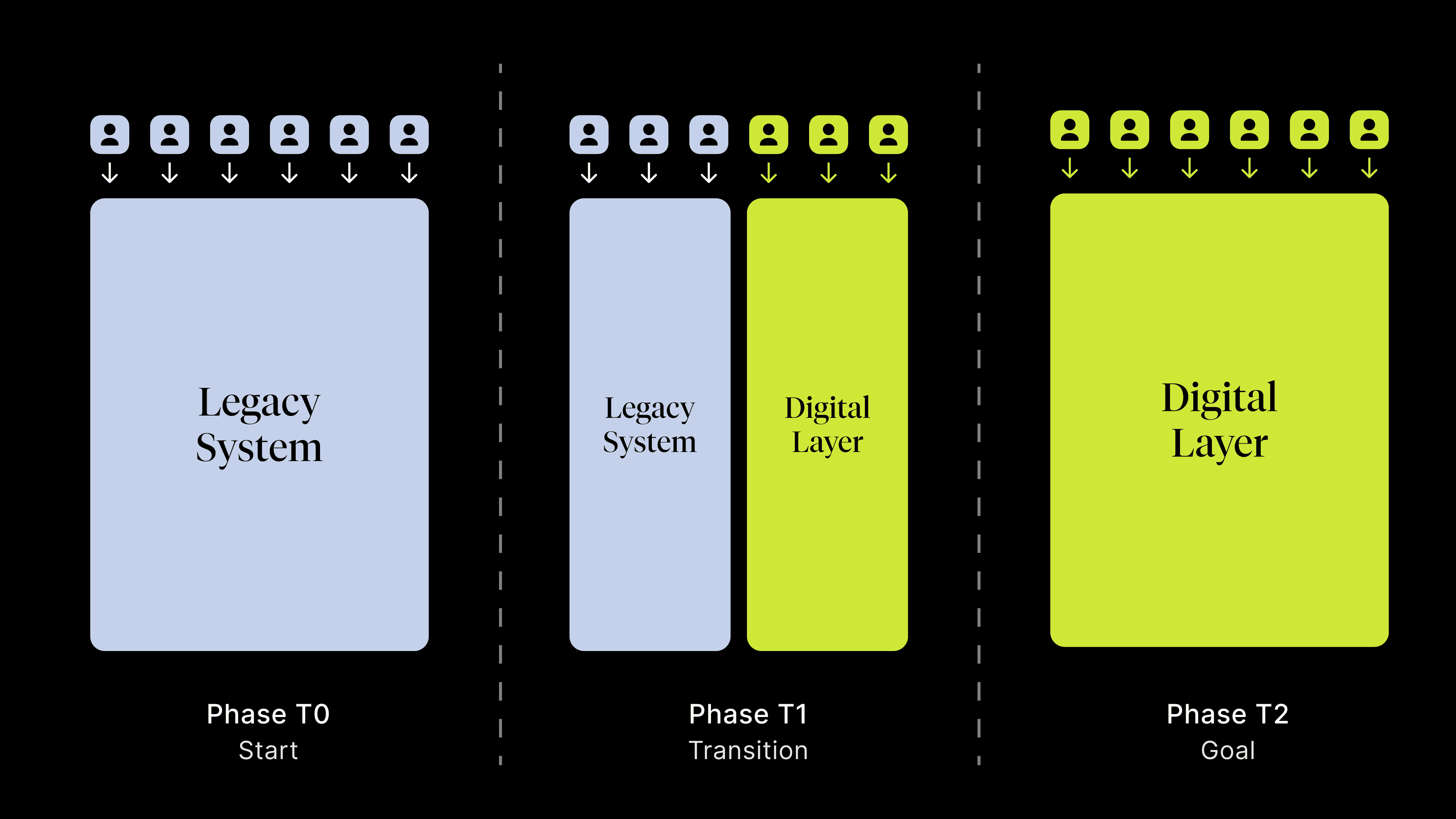
This is a strategy for the gradual migration of functions from the old system to the new environment without any interruption in operations. New business requirements are developed exclusively in the modern layer, and the original functions are gradually migrated there, one use case at a time. Both systems run in parallel until the original module is completely replaced. However, this approach requires a high degree of project discipline. If the migration process is not brought to a successful conclusion, the institution will be left with two parallel systems and the associated ongoing increased maintenance costs.
Microfrontends
Microfrontends allow the client interface to be divided into independent modules that separate teams can work on and deploy without depending on one another. For medium-sized and smaller digital products, however, this is unnecessary architectural over-engineering that makes it difficult to maintain a consistent UX and unnecessarily burdens the application’s performance.
Practical tips for integration APIs or BFFs
To ensure that the new architecture provides long-term stability for the solution, we rely on five fundamental principles that must be part of the discussion from day one.
- Map the core system before writing the first line of code: Before beginning development of a new layer, it is essential to analyze the core system through real-world testing and consultations with the internal team, as official documentation rarely captures the system’s actual behavior in production.
- Plan for imperfect data: Legacy systems may return erroneous, incomplete, or historically inconsistent data that needs to be corrected or supplemented before being displayed in the application. The integration layer should therefore have clear validation rules and handle invalid data in such a way that errors from the core system are not passed directly on to the user.
- Caching strategy from day one: Calls to legacy systems tend to be slow and infrastructure-intensive. Data that is not subject to constant change should be cached, for example, using an in-memory database like Redis, which significantly reduces the response time of the entire application. This approach will significantly reduce system latency and improve the user experience.
- Audit and security as part of the design, not an afterthought: Every request passing through the integration layer should be logged, have rate limiting implemented, and undergo authorization checks at the individual endpoint level. In regulated industries, you must also be prepared to trace audit logs retroactively and demonstrate who accessed or modified what data, and when. For clients, we typically address this by integrating with their existing security monitoring tools (SIEM systems).
- Minimizing sensitive data: Only those attributes that the front-end application actually needs to display to the user at a given moment should be sent from the core system via the API.
Complete rewrite or a gradual transformation?
The decision to completely replace a legacy core system with a new, greenfield solution may be the right path for smaller organizations or systems at the very end of their lifecycle. This eliminates technical debt and provides the institution with a modern stack on which it can safely build.
For major players in the banking or insurance sectors, however, a complete rewrite carries extreme risk. It represents a massive investment spanning several years, during which the original system must be maintained and funded in parallel. Functionality is often undocumented and exists only in the team’s collective memory, while data migration tends to be orders of magnitude more complex than initial estimates suggest. That’s why at GoodRequest, we never make decisions about the form of transformation on the fly; we always base them on a detailed audit of the system’s current state, the team’s capabilities, and the business’s strategic goals.
Where to start
Based on our experience, we recommend that clients begin their transformation with three pragmatic steps:
- Define a single business use case: Don’t try to change the entire architecture right away. Select one specific client process (e.g., digital account opening or online claims settlement).
- Map the data flows: Verify which data this process requires from the core system and in what form it is actually available via existing APIs.
- Build a working prototype: Create a limited digital layer for this one specific use case. At GoodRequest, we build working prototypes within a few weeks. A tangible result is the best way to advance internal discussions about transformation, as it reveals real integration limitations rather than hypothetical assumptions.
This approach gives you three things at once: concrete insights into the state of the core system, a first functional product for users, and a credible plan for broader transformation.
Let’s take a look at your specific tech stack
At GoodRequest, we have a team of designers, front-end, and back-end engineers who have successfully guided several institutions in the banking, insurance, and fintech sectors through this process. We’d be happy to review your current situation with you and suggest the first steps toward change.
Martin Macík
Head of Business
Conclusion
The original core system may not be the reason why an institution’s digital products are stagnating. A stable core and a modern client interface are two distinct disciplines, and from both an architectural and a business perspective, it makes the most sense to let each evolve at its own pace. Tools such as a separate integration layer, BFF architecture, or a strategy of gradual feature migration will allow you to maintain a high pace of innovation. Thanks to them, you can respond flexibly to the dynamic financial market without risking the stability of the systems that support your day-to-day business.