The quality of a digital product depends on the people who create it. And that holds true even today, as AI enters the picture. The difference between a team that merely follows instructions and a team that thinks through problems doesn’t become apparent right at the start of a project. It becomes clear the moment things stop going according to plan. That’s why we’re extremely selective about who we bring onto the team. Here’s a behind-the-scenes look at how we hire the best.
Why hiring matters more than it seems at first glance
If you’ve ever worked with an external team, you may have encountered different approaches. The standard model is based on providing the specific skills of a developer, designer, or project manager. And that’s a perfectly valid way to collaborate.
It works. Until something goes wrong. The problem arises when a decision needs to be made that isn’t in the ticket:
- something doesn’t quite fit the scope,
- a technical limitation arises,
- or the client expects something that wasn’t explicitly specified.
That’s when the difference becomes clear between a team that waits for the brief and a team that questions it.
On our projects, we strive to operate as the latter. We’re interested not only in the brief itself, but also in what lies behind it, why it was created, what it’s supposed to achieve, and where it might go wrong.
That’s why we look for people on our team who can spot a problem before it costs money, question the assignment when it makes sense to do so, and take responsibility for the result, not just the task. It’s a more demanding way of working together and doesn’t fit every project, but it’s precisely in this approach that we see the greatest long-term value.
A process that reflects the reality of collaboration
If you want a team that will contribute to product quality and customer satisfaction, you can’t just put one together at random. For us, the hiring process serves as a filter for skills, but above all for mindset.
That’s why our selection process is multi-stage and relatively rigorous. It’s not about finding out “who can stick it out,” but about gathering enough information to make a sound decision.
We take our time with the selection process. If we don’t feel it’s a good fit, we’d rather leave the position open longer. Over the long term, we’ve found that patience works better than quickly filling a position.
The entire process typically takes:
- ~1 month for technical positions
- ~1.5 months for project roles
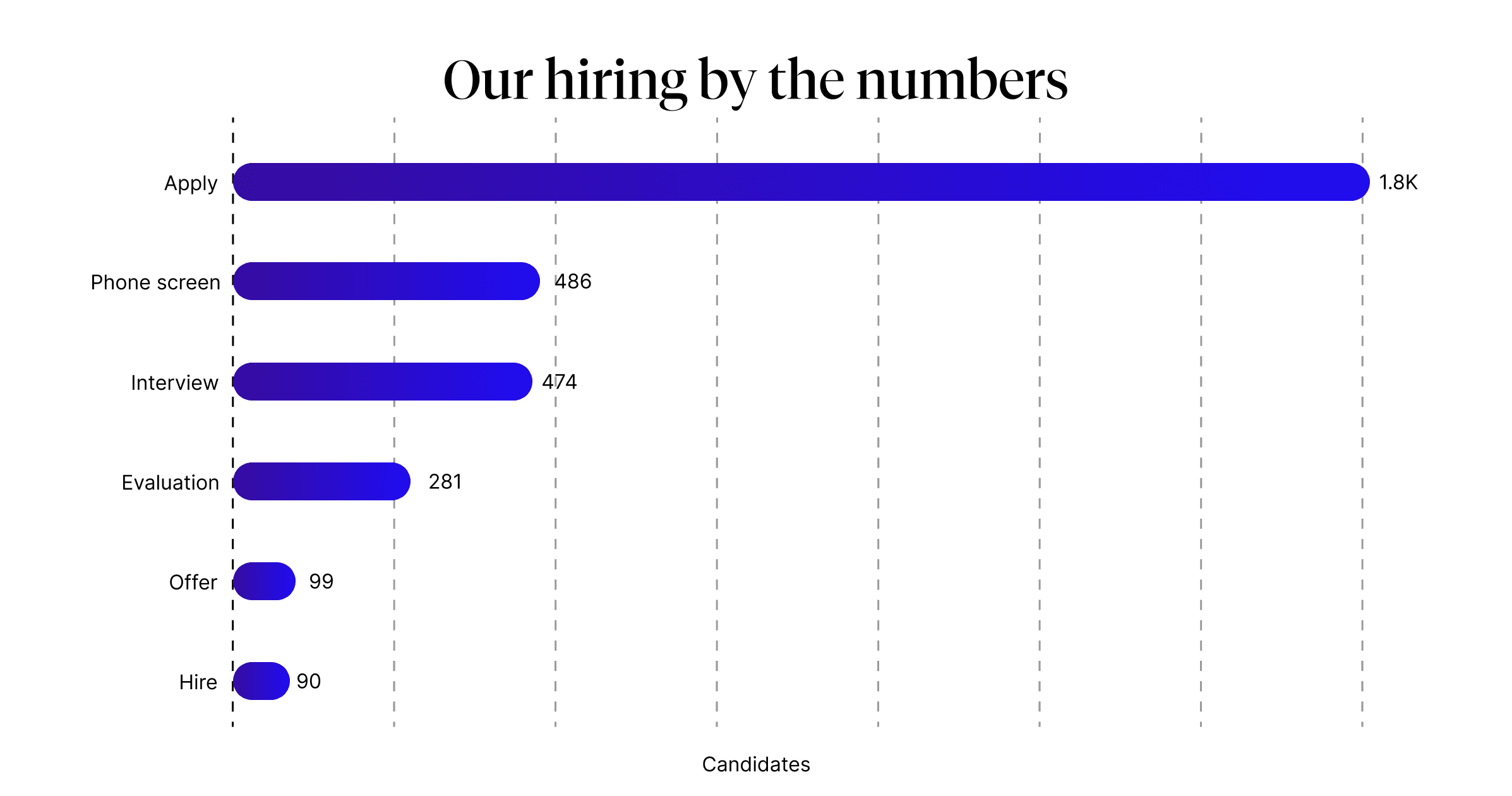
As a result, approximately 5% of candidates join the team. Not because the others aren’t good, but because we’re looking for a specific alignment in how we work and what we expect from the collaboration.
What does the process of joining our team look like?
For us, hiring isn’t just about a single interview. Each step is designed to help us better understand how a candidate works. We’re not just interested in the result, but especially in how the candidate arrives at it.
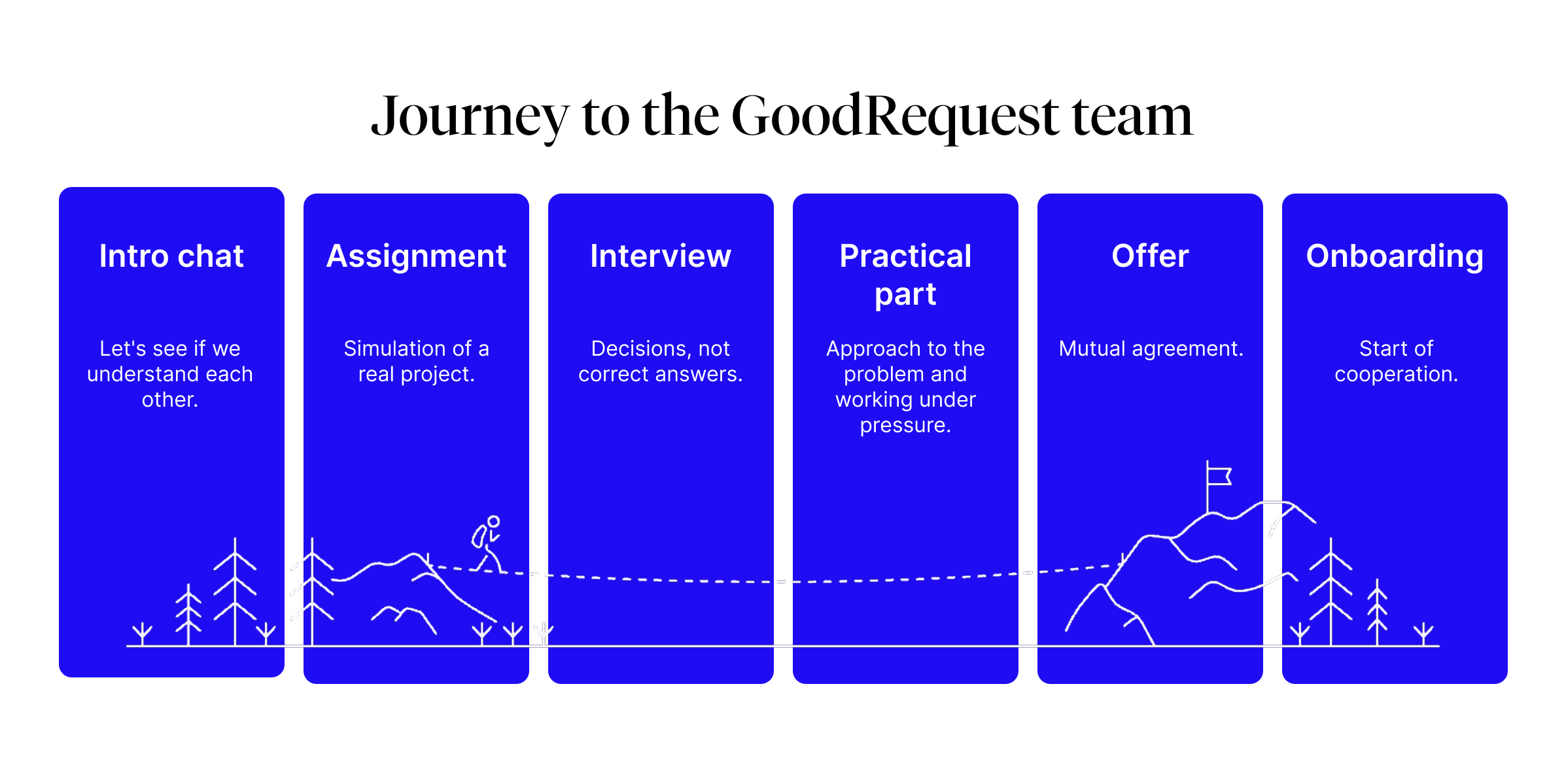
First “date” (intro chat)
The process begins with a short, approximately 30-minute phone call.
We stick to the basics:
- what the candidate does and what experience they have,
- what they’re looking for,
- and whether we’re on the same page regarding our work styles.
We often call in everyday situations: during work, on the go, between meetings. That’s intentional. It helps us see the candidate naturally, without much preparation. At this stage, the goal is to determine if we’re on the same page regarding the basics and if it makes sense to move forward.
Reality-based assignment
If we decide to continue the process, a take-home assignment follows, simulating real-world tasks from our practice. We recognize that producing a high-quality solution for such a project requires a significant time investment, so we strive to ensure it is meaningful.
Every single solution is reviewed by our senior developers, who provide detailed feedback. Not just to “check the task off the list”, but to understand how the candidate thinks in a situation that closely resembles a real-world project. Even candidates who don’t advance leave with valuable feedback on their code.
The fact that this approach makes sense is also confirmed by the stories of our colleagues. We have people on our team whom we rejected on their first attempt. Thanks to the feedback, they knew what to work on. After some time, they returned stronger, and today they are an important part of our projects.
Interview (& Live coding)
The interview has a structure, but we let it flow naturally. We start with the candidate’s experience, move on to feedback on the assignment, and conclude by giving the candidate an opportunity to ask questions.
Throughout the process, we place greater importance on how the candidate thinks than on whether they have all the answers correct. After all, there is rarely a single correct solution on a project. What matters is who makes those decisions and how the team arrives at them. At the same time, we’re interested in whether the candidate can defend their decisions, how they respond to feedback, and whether they can reflect on things they would do differently today.
The interview is followed by a practical section, the format of which varies depending on the role and seniority. For developers, this often involves live coding; for other positions, it tends to involve simulated scenarios. We observe how the candidate approaches the selected problem, whether they know how to ask questions, how they respond to guidance from a senior team member, and how they handle the moderate pressure that naturally comes with the job.
The result? Even during the hiring process, we can identify fairly precisely where a person’s strengths lie, where they have gaps, and how best to support them after they join the team.
Welcome to GoodRequest! 🎉
If there’s a spark on both sides, an offer follows.
For us, collaboration doesn’t begin with signing a contract or the first day in the office. We stay in touch with new colleagues even before they start, so that the transition to a new environment isn’t a leap into the unknown.
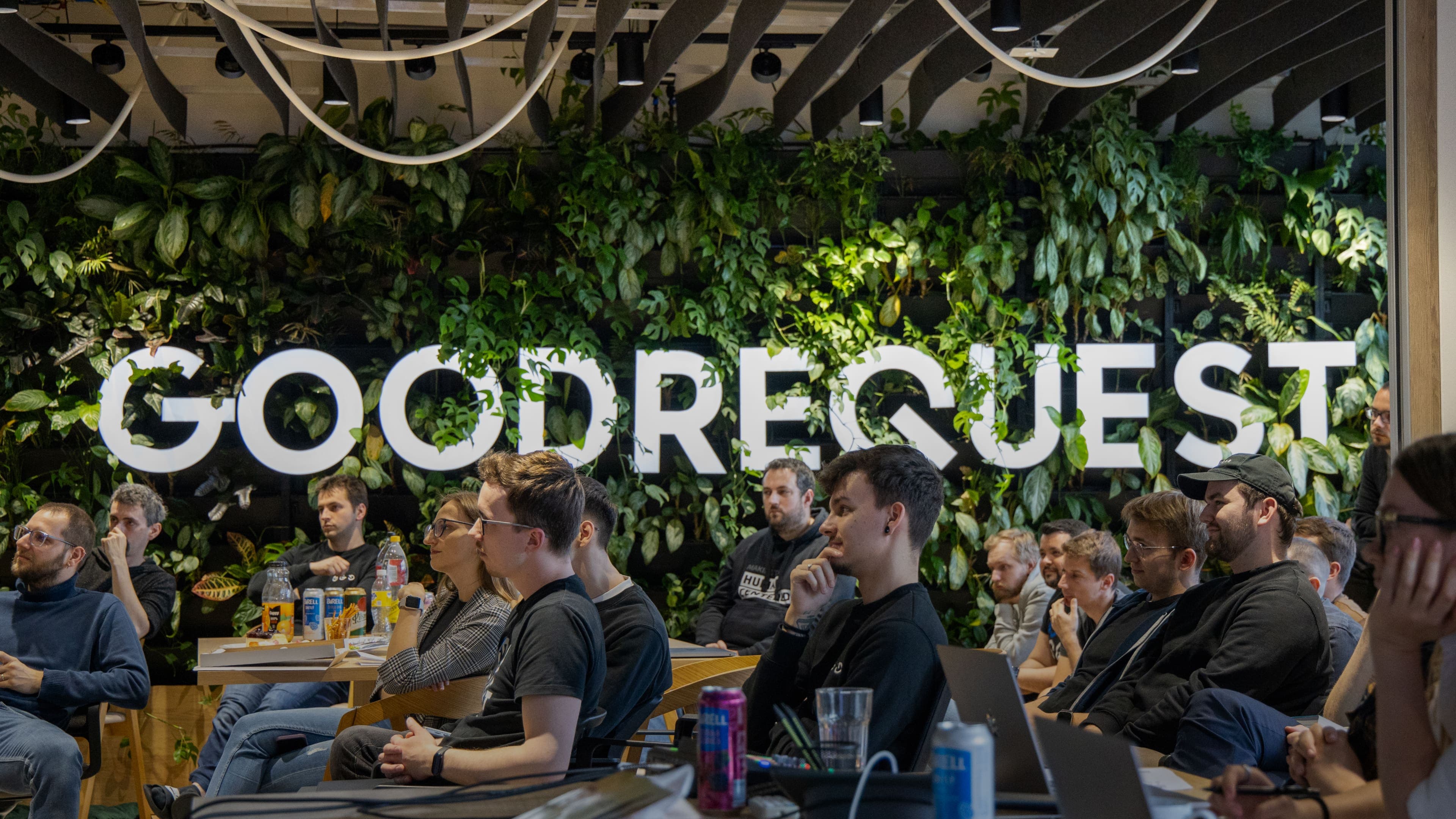
Onboarding
Upon joining, every new hire goes through an onboarding process during which they meet with colleagues from the People team, IT, and project management. The platform lead also schedules meetings with the teams the new hire will be working with, so they can better understand their perspectives and how everything fits together.
Part of the onboarding process is also a meeting with the CEO. It’s not exactly standard practice, but it makes sense to us that every new employee understands where the company is headed, how we think, and what we expect from one another.
We’ve long strived to build teams where experienced people are well-represented. At the same time, it’s important to note that a large portion of our senior staff has grown up internally. We have a system in place that allows juniors to grow relatively quickly, thanks to projects, feedback, and teamwork with more experienced colleagues.
Why do we care so much about all of this?
The entire process naturally reveals how we work and what matters to us.
We take the selection process seriously not for its own sake, but because of what it will influence later on:
- how the team thinks,
- how it makes decisions,
- and how it handles moments when things don’t go according to plan.
For the client, this means one thing: they don’t just get capacity, but a team that can drive the project forward even when the assignment isn’t enough.
As our CEO Tomáš says: “If you view people as your most valuable asset, it will bring you great rewards.”