
Imagine you’ve invested thousands of euros in SEO. Your website is technically sound, your content is growing, and you’re holding your position on the first page of Google search results. On paper, it looks perfect. However, reality is starting to unfold differently: traffic is dropping, the number of relevant search queries is decreasing, and customers seem to have “disappeared.”
The research firm Gartner predicts that traffic from traditional search engines will drop by 25% by 2026. The reason is simple. People no longer want to click through 10 search results and piece together an answer from multiple pages. They want an immediate, synthesized answer that AI can provide, whether through ChatGPT, Perplexity, or Google AI Overviews.
So the question is no longer whether you’re number one on Google. The question is: will your brand be part of the answer that AI generates?
Welcome to the world of Generative Engine Optimization (GEO).
SEO vs. GEO in 30 seconds
- SEO – Helps people find you.
- GEO – Determines whether AI will consider you a trustworthy source and cite you.
GEO does not replace SEO; it is its essential technological evolution. Neither can survive without the other today.
From clicks to citations: What’s changing for business
1) Fewer clicks don’t mean less interest
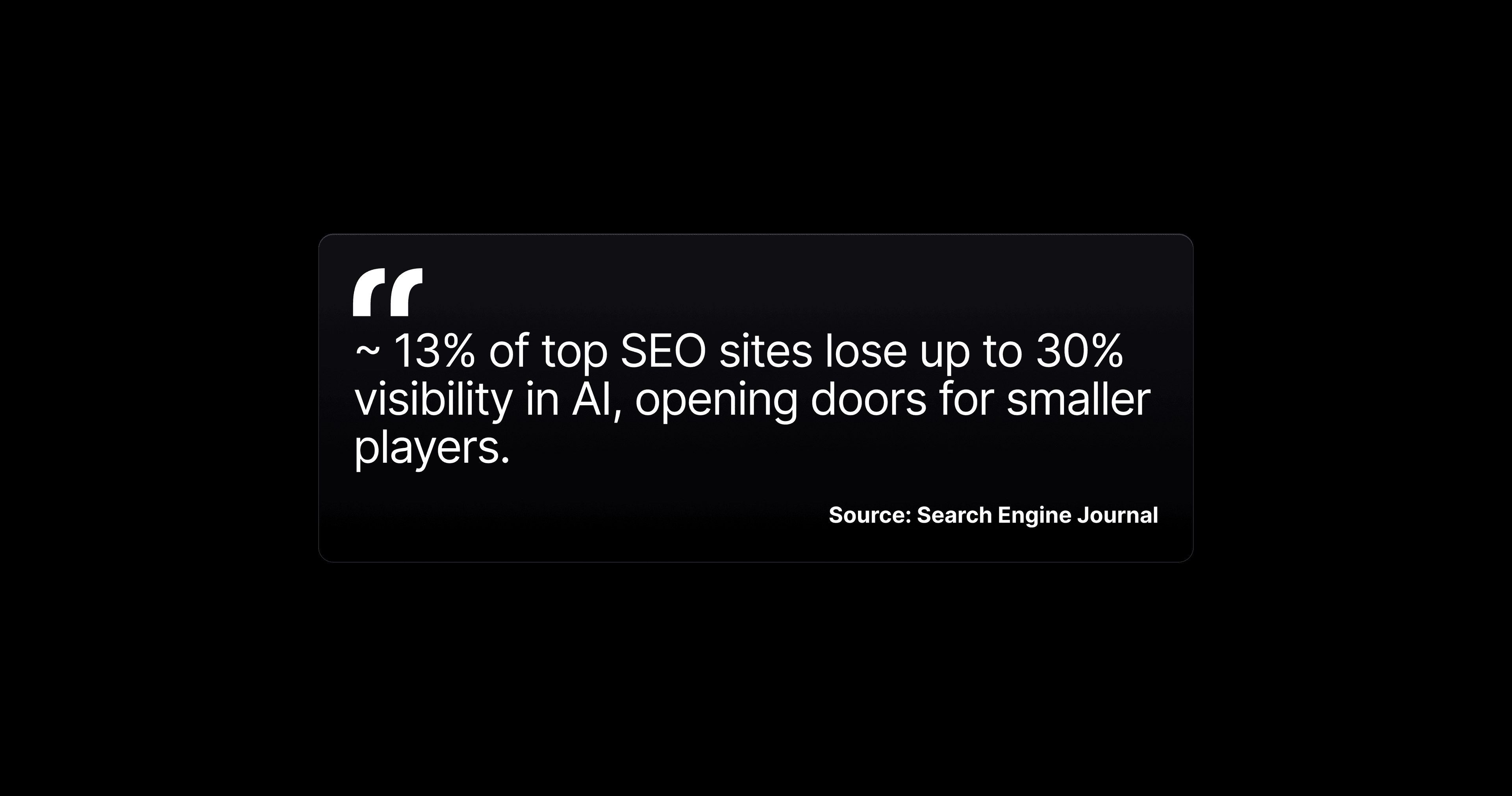
Some users have stopped clicking through to websites because they get their answers directly in AI interfaces (ChatGPT, Perplexity, Google AI Overviews).
If AI doesn’t include you in its synthetic response, you basically don’t exist for part of the market, even if you’re “optimized.”
2) AI shortens the buying journey
When making a purchase (both B2B and B2C), a large part of the research is already done before a person even opens your website. AI compares options, highlights key points, and often directly suggests a shortlist.
That’s why the logic of success is changing: getting a click is less important than getting a mention or a citation.
What your content and website need for AI to "read" and cite you
AI has no eyes; it can’t see your beautiful design or polished UX. It sees structure and context in the code. If a website is unstructured, even good content can end up being invisible.
✅ GEO-ready checklist (for marketing and tech)
- Semantic HTML: lists should be actual lists (
<ul>,<li>), articles in<article>, and headings in a hierarchy. This helps AI navigate what’s essential. - FAQ sections as an AI magnet: questions and brief answers mirror the way both people and AI ask questions.
- Schema markup (JSON-LD): explicitly describe the context (product, service, review, author, FAQ). It acts as an interpreter for machines.
- Key content without JavaScript barriers: many bots cannot render complex JS. Key information must be accessible directly in HTML.
- Authorship and E-E-A-T: AI models prefer sources with a clear identity. We implement extended schemas for authors and organizations so that AI knows who is providing the information, not just what is being said.
- llms.txt: a supplementary layer to
robots.txtthat gives AI models clear instructions and access to the most important content.
How to Measure Success in GEO: 3 KPIs That Make Sense
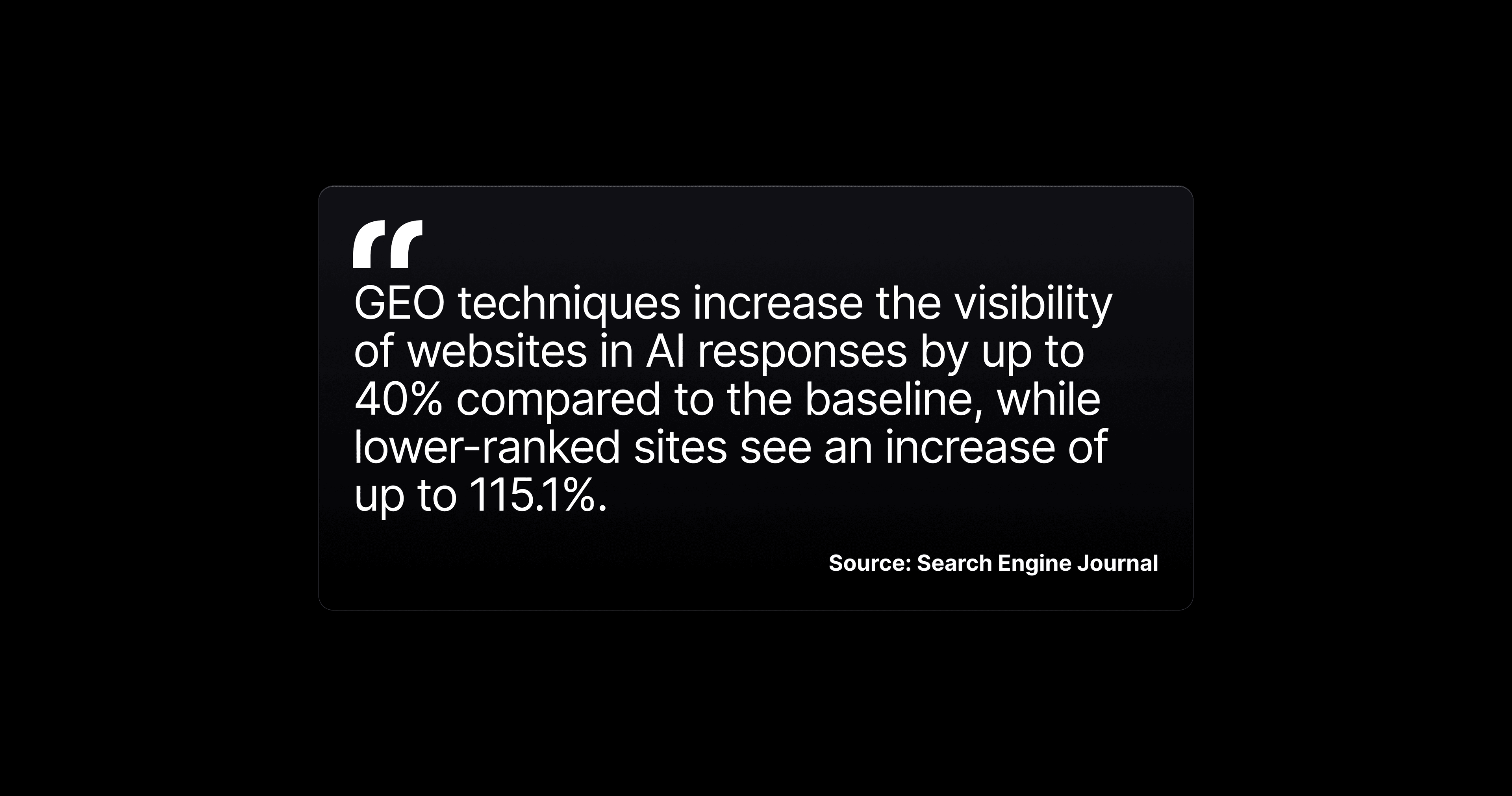
If you’re only chasing CTR and traffic volume, you might be overlooking what really matters. GEO drives conversions. Market examples show that conversion from AI recommendations can be up to 25 times higher (GoFish) compared to regular search (around 27% – Braworks). That’s because AI users aren’t just “browsing”, they’re in buyer mode.
If you want to know whether your brand is growing in the AI era, watch for three signals:
- Citation frequency: how often your brand or website appears as a source in AI responses.
- Increase in brand searches: AI recommends you, and the user then searches for you directly.
- AI sentiment: whether AI speaks positively or neutrally about you, or mentions you in the context of outdated or negative sources.
Where to start right away (practically)
Open Google Search Console and check your search queries. If long, descriptive sentences and very specific questions start appearing, these aren’t SEO mistakes, but proof that people are asking Google (and its AI layer) the same way they would ask a human. Your website must be ready to answer these “long-tail” questions.
GEO checklist
- We have scannable content (headings, bullet points, FAQs), not a “wall of text.”
- We demonstrate our expertise concretely (examples, experience, data), not just through claims.
- The website is technically readable by AI (semantics, schema, no JS barriers).
- We measure new signals (citations, brand search, sentiment), not just CTR and rankings.
- We regularly test what AI answers to our ideal customers’ questions.
Traditional SEO put you on the map. GEO ensures that someone actually recommends you from that map. At GoodRequest, we don’t just build websites and apps. We design digital products with clean semantic architecture that AI models understand “out-of-the-box.”