

AI adoption is skyrocketing, but the value it delivers is growing much slower. The difference between a proof of concept sitting on the shelf and a solution in production isn’t in the model itself, but in where you consciously deploy AI and where you don’t.
These days, there are probably very few companies that aren’t working on some kind of “AI initiative.” Management is asking for innovation, competitors are using every ChatGPT wrapper as a PR stunt on LinkedIn, and teams are given the task: “Find something where we can use artificial intelligence.”
This creates an absurd situation: we’re looking for a problem to fit a pre-selected solution. The result is often expensive projects that nobody actually uses.
At GoodRequest, we’re fans of technologies that make sense and deliver real added value, not those that end up in a drawer. AI is a tool with enormous potential today. However, the best results aren’t achieved by companies that deploy “some AI” as quickly as possible, but by those that know where AI has the greatest impact and how to integrate it into the rest of the system so that the entire solution works in production.
Why is everyone rushing to adopt AI
AI is now the number one priority on C-level agendas, and few can afford to ignore this trend. According to McKinsey data, AI adoption in companies is steadily growing:
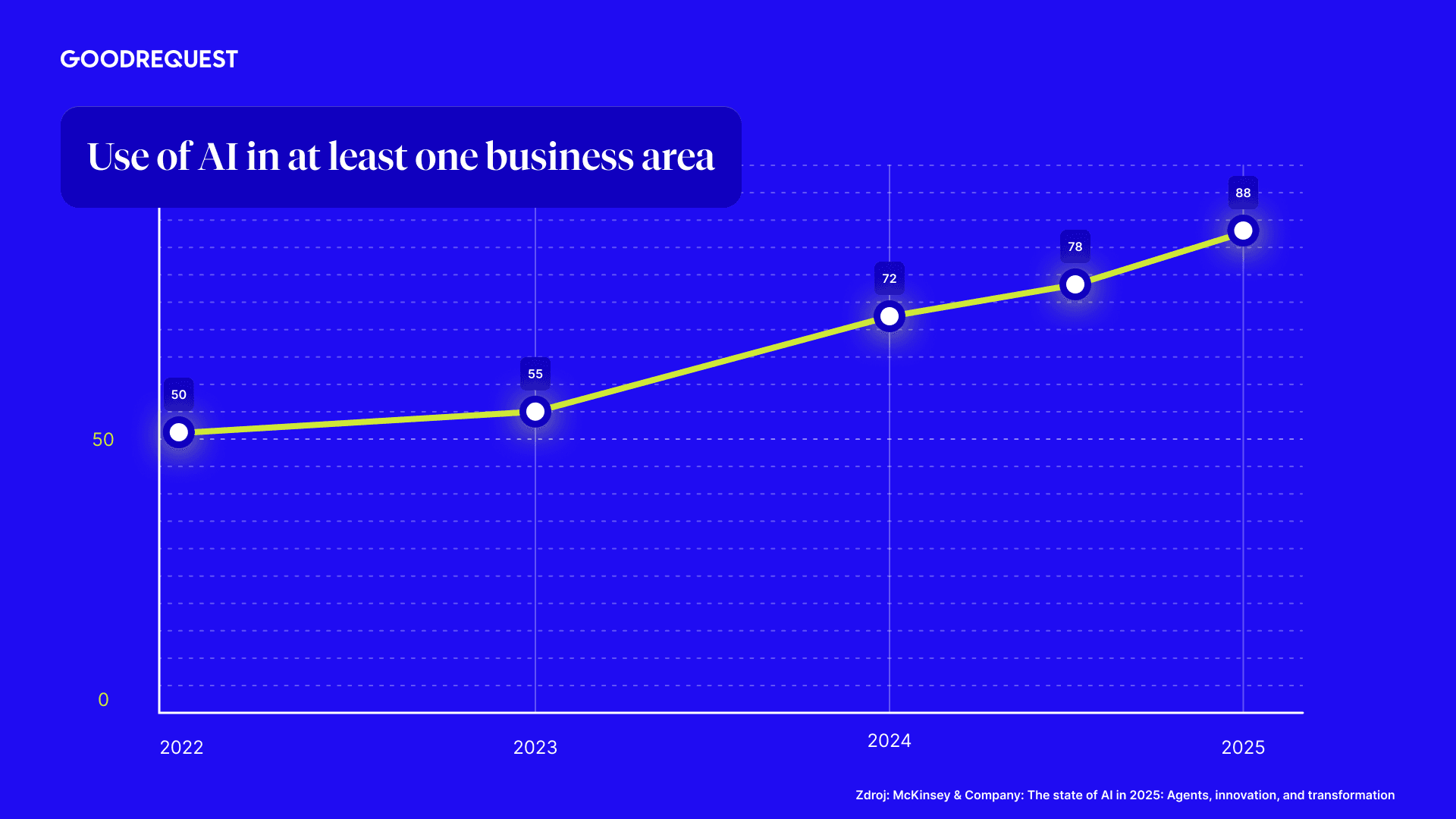
But there’s a huge difference between “adopting AI” and “getting real value out of it.” This is where many companies run into trouble. A project launched solely to meet an “innovation” quota rarely survives its first year in live operation.
What sets AI projects that make it to production apart
Based on the projects we’ve delivered and what we see with clients even before Pathfinder, it’s quite clear what makes the difference between a PoC that ends up in a drawer and a solution that scales. It’s not about a model or a framework. It’s about three layers that must be in place before construction begins.
- A map of the process into which the AI is integrated: We know exactly where the decision falls in the workflow, who makes it today, based on what, and how its correctness is measured. Without this, every AI decision is a black box.
- A data foundation on which to train and evaluate: A consistent schema, interconnected sources, and accessible historical data. No amount of tuning can save the quality of the model if the inputs lack integrity.
- Metrics by which we can say “this is better”: Conversion, processing time, classification accuracy, false positive rate. Anything measurable and justifiable to the business.
If any of these layers is missing, we address it first. Not because we’re putting AI on the back burner, but because without it, you can’t tell if the model actually works.
Rules vs. Probability: What do you really need?
AI and automation are two concepts that businesses often confuse, even though they operate on completely different principles.
- Automation (Rules): It works on the principle of “If X occurs, do Y.” It is predictable, repeatable, and immediately verifiable.
- AI (Probability): It learns to recognize patterns. It makes decisions where rules are insufficient. It requires training, time, and ongoing monitoring.
Real-world example: At a bank or payment institution, you want every approved transaction to trigger a chain of steps: authorization, posting to accounts, generating a confirmation, recording in the general ledger, and notifying the client. Here you use an event-driven workflow: deterministic, audit-friendly, and compliant with regulations (PSD2, AML). However, if you want to use those same transactions to assess in real time whether a transaction is fraudulent, or to predict which client is likely to fall behind on a payment, and adjust limits, step-up authentication, or communication accordingly. That falls into the realm of AI.
When we deliberately avoid using AI
The hardest decision in an AI project isn’t “where to deploy it?”, but “where to deliberately avoid deploying it?”. In digital products, there are entire layers where AI would introduce uncertainty, break the audit trail, or consume computational resources without providing any measurable benefit.
Where deterministic logic takes precedence:
- The product’s transactional core: Payment processing, order fulfillment, tax document generation. Here, you need 100% reproducibility and an audit trail. Probabilistic decision-making conflicts with what regulators (PSD2, GDPR) and your CFO expect from you.
- Integrations between systems (CRM ↔ ERP ↔ data warehouse): Data synchronization, transformations, validations, retry policies. A classic case for an event-driven pipeline. AI has nothing to predict here: either the data arrives correctly, or the mapping needs to be fixed.
- Onboarding with conditional logic: KYC in financial services, registration with VAT validation, multi-step setup in B2B SaaS. The branching is finite, the rules are regulated, and the result must be defensible in an audit.
In these layers, AI does not add value; on the contrary, it worsens the solution. That is precisely why it is essential to know where the foundation must be solid so that AI can build on it safely.

Where AI delivers results that automation cannot achieve
AI makes sense where rules are either unmanageably complex or would have to account for a level of variability that can only be captured through machine learning.
This is where AI delivers an ROI that automation cannot:
- Extraction from unstructured documents: Invoices, contracts, claims forms, medical reports. Templates vary, languages mix; OCR plus rules would require hundreds of exceptions and still fail to capture reality.
- Real-time decision-making with context: Fraud detection in payment flows, dynamic pricing based on demand and competition, lead prioritization based on behavioral signals. There are too many inputs, and they change too quickly for static rules.
- Classification made difficult by language and context: Moderating discussions, categorizing tickets by intent, evaluating sentiment in customer communications. Where the same statement means the opposite in a different context.
- Conversational interfaces with memory: Not a generic chatbot, but an assistant that works with a specific client’s documentation, their data, and interaction history, and can refer back to the source.
What it looks like when it works
In the most successful projects, AI and deterministic logic aren’t at odds with each other. They are layers with different roles. The architecture is well-thought-out, not a compromise. In practice, this means four layers that together support the product:
- Deterministic core: Business-critical logic that must be 100% repeatable and auditable. There is no place for AI here.
- AI layer: It sits exactly where it creates the most value: extraction, classification, prediction, contextual decision-making. Not everywhere, only where it has an advantage over rules.
- Human-in-the-loop: Edge cases, high-risk decisions, and continuous model fine-tuning. People aren’t a backup for bad AI; they’re part of the design.
- Observability and guardrails: We see what the model is doing, when it makes mistakes, and we can stop it or switch to a fallback before the user experiences a failure.

How we built it for Elv.ai
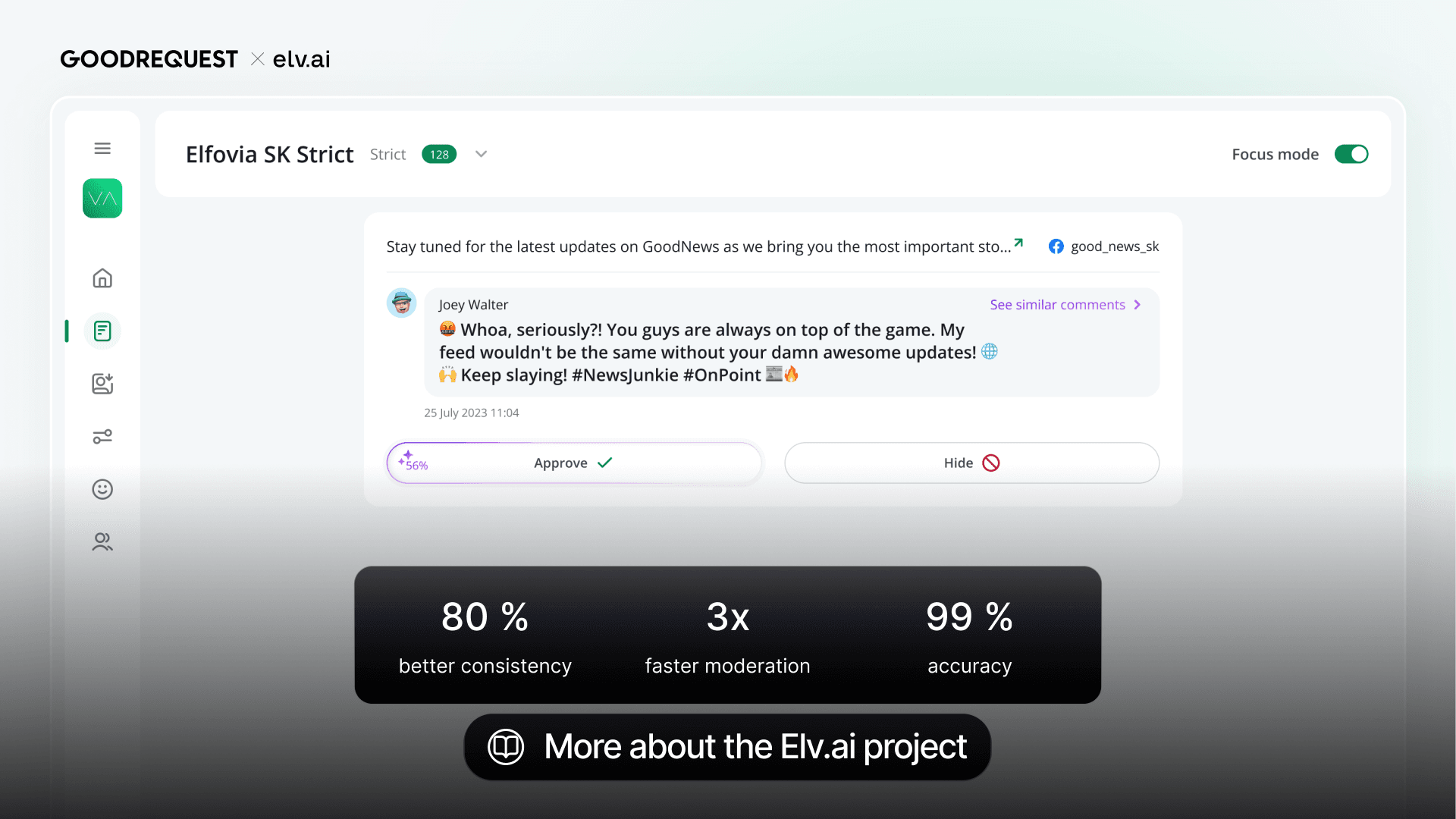
For the startup Elv.ai, we tackled a problem that rigid rules alone could never solve: moderating online discussions in Slovak, Czech, and Polish, where the meaning of a comment is determined by sarcasm, dialect, and the context of the preceding discussion.
A rule-based filter (blacklist of words, regex) would fail here in both ways: it would either let through toxic content disguised as euphemisms or delete legitimate criticism. AI alone, on the other hand, would not be trustworthy enough for decisions that affect clients’ freedom of expression in the media space.
The solution we built combines both layers intentionally, not out of necessity: the AI model sorts through most comments and relieves human moderators (so-called “elves”) of the most toxic content. Humans, in turn, handle borderline cases, coach the AI where it is unsure, and perform quality control. The infrastructure is designed to handle peaks without a cost explosion.
The result is scalable moderation that has proven itself to media companies and public institutions in three countries—a solution that neither pure AI nor pure automation could deliver on its own. Read the full Elv.ai case study.
Our approach: AI Pathfinder
We don’t design AI solutions just because they’re trendy. Our goal is to deliver a product that offers a clear return on investment. That’s why we at GoodRequest have created AI Pathfinder, a structured program that helps us determine together whether and where AI makes real sense for your business.
We follow a four-step process:
- 01
Screening meeting
We’ll get to know you, your company, and the goals you want to achieve.
- 02
Joint Workshop
We will define the innovation goals and identify key areas for the Proof of Concept.
- 03
Analysis and Solution Design
We analyze AI implementation options and build a PoC.
- 04
Presentation and Proposal for Collaboration
We will present a concept for the solution and propose next steps.
The goal is neither to deploy AI at any cost nor to avoid it altogether. The goal is to build a solution that actually works in production, delivers a measurable return on investment, and can withstand audits, regulatory scrutiny, and future rounds of growth. Most often, AI serves as an add-on to a well-thought-out foundation; sometimes it is the main architectural layer, and sometimes it is part of a larger stack.
Are you planning an AI project, or do you already have a specific use case on the table? As part of the AI Pathfinder consultation, we’ll work together to identify where AI has the strongest impact in your product and how to implement it so that the project moves from PoC to production.