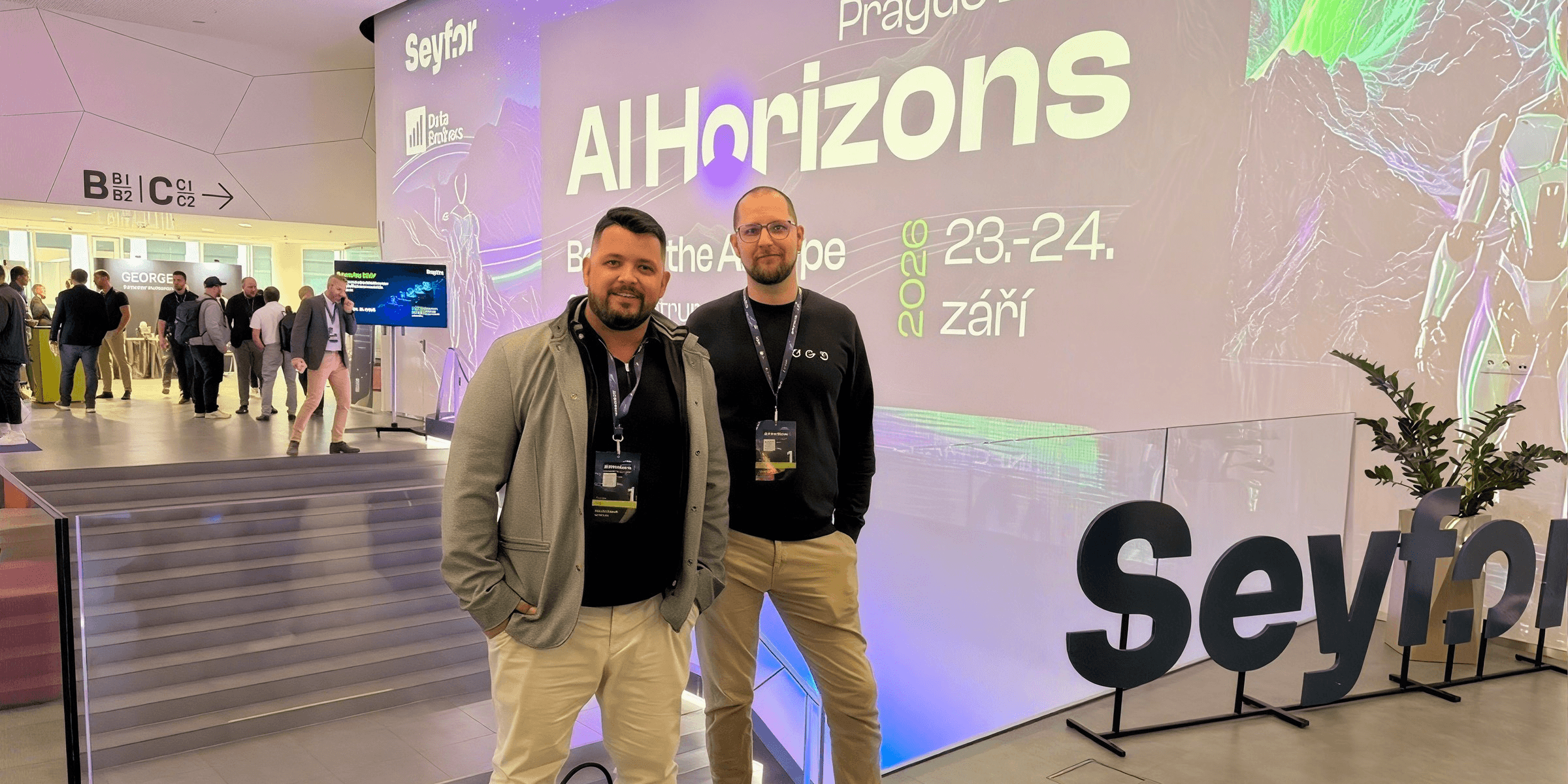
Choosing an AI model is easy these days. The harder part is finding out whether you can rely on it for a specific task, and what happens when it changes or becomes unavailable. These are exactly the questions that caught our attention at AI Horizons 2026 in Prague, the ones that come after the initial excitement about the technology.
We came away from the event with three perspectives on AI in practice: how to evaluate language models, how a robot learns from humans, and what businesses can learn from the public sector.
The Best Model on Paper Isn't Necessarily the Best One for Your Project
When choosing an AI model, it's easy to rely on benchmarks. They are useful for comparing general capabilities, but on their own, they won't tell you how a model will perform with your data, your required output format or an ambiguous instruction.
This was also a point raised in a talk by David Pavlík, Chief Product Officer at BottleCap AI. Its project, AI Scan, explores the behaviour and preferences of language models. It got us thinking about a simple question: why not test a model before deployment in much the same way we'd assess a candidate in a job interview?
A CV tells you what someone has achieved. An interview shows you how they approach a problem you put in front of them. It's similar with a model. We're interested not only in whether it gives the right answer, but also in whether it follows the required format, admits when it's uncertain or confidently makes something up.
A good starting point could be a short test set of 10 to 15 tasks taken from a real project. We can then use the same tasks to compare different models and retest them after updates. Keeping the responses on record makes it easier to spot whether the model's behaviour has deteriorated.
This kind of testing also makes sense from a cost perspective. For some tasks, a smaller or less expensive model may be enough, provided it delivers the required level of quality. When scaling across multiple processes or an entire organisation, differences in speed and cost can become significant. Availability matters too. If AI is part of a critical process, you need to consider what happens when a model goes down and whether there is a suitable alternative.
A Robot That Humans Can Teach to Perform a Task
At the conference, we had the chance to try out the robotic arm of GEORGE, a humanoid robot being developed in Czechia. Beyond the hardware itself, we were interested in how its creators approach learning and the distribution of skills.
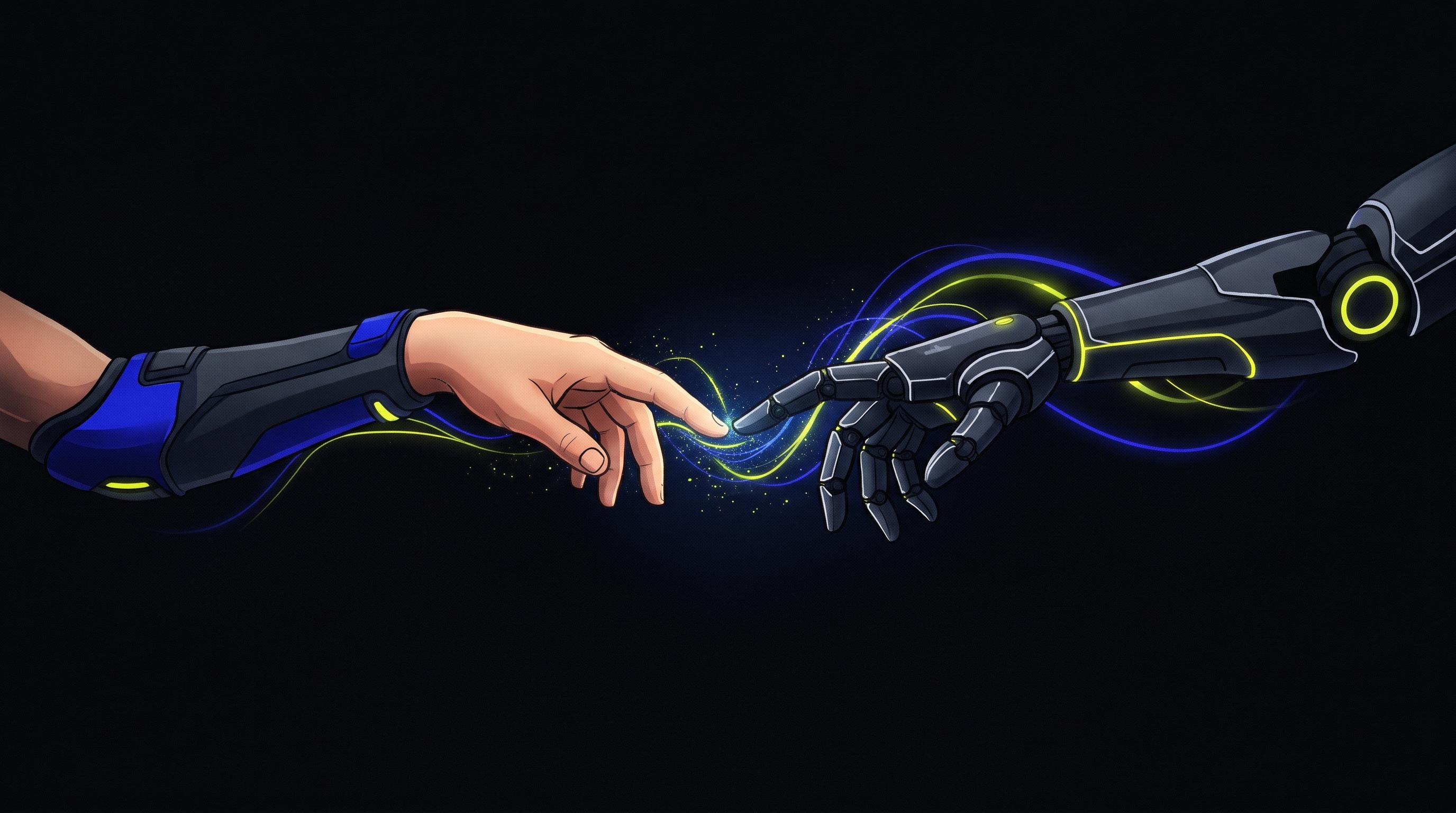
According to the creators of the GeorgeOS platform, a human can teach the robot a task using an exoskeleton. The learned procedure then becomes a skill that can be transferred between robots. A familiar software principle is making its way into the physical world, where the result is no longer limited to a screen.
With this approach, the important question is whether the robot can perform a specific task in the environment it is designed for. A demonstration is just the beginning. Its real value will become clear when the skill can be used safely and reliably in day-to-day operations.
We're also glad to see a project like this being developed in our region. It's encouraging to see European teams not only using technology, but developing it themselves.
What Can Businesses Learn from the Public Sector?
We were pleasantly surprised by how many discussions about AI in the public sector focused on processes. Participants talked about data protection, audit trails, people's responsibilities and procurement. These are the things that determine whether an idea can move beyond a pilot project and become part of everyday operations.
One interesting example outside the conference itself is the AI hackathon organised by the Czech Ministry of Foreign Affairs. In December 2025, the Ministry organised it together with Microsoft and Seyfor. Subject matter experts joined forces with IT specialists, and four application prototypes were developed over three days. The Ministry later also introduced Curia, an application designed to support the work of the Government Agent before the Court of Justice of the EU.

Four prototypes don't mean four finished products. They do, however, show the value of bringing together people who understand the problem and people who know how to design a technological solution. A prototype helps validate assumptions before an organisation commits to a larger project.
Another example that caught our attention at the conference was VZMR Checker, a tool focused on checks in the area of public procurement. We see its value primarily in its clearly defined scope. When we know exactly what the tool is supposed to check and who is responsible for reviewing its output, it's easier to set clear boundaries for how it should be used.
The same approach makes sense in business. Instead of asking, "Where can we use AI?", it's worth starting with a specific process. Who makes the decisions within it? What data does it use? Which steps are repeated, and how will we verify the results? Only then does it make sense to choose a tool.
What Are We Taking Away from AI Horizons?
For us, the most valuable theme of the conference wasn't a single model or device. It was the journey from an interesting demonstration to a solution that makes sense in a real-world environment.
For our next AI project, we want to start with real tasks, test how the model behaves and document the results. We also want to ask who will review the outputs, what happens if the model becomes unavailable and whether the process is ready to adapt to change.
Technology can be a good starting point. But its true value is determined by how it works in practice.